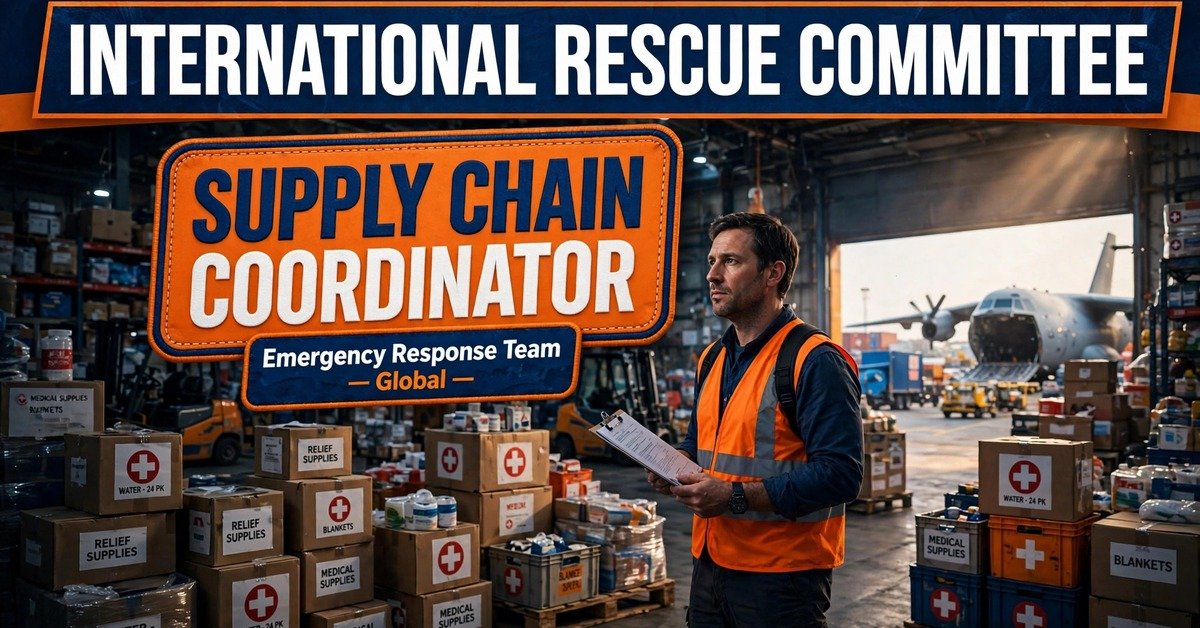
The International Rescue Committee (IRC) is hiring an Emergency Response Team (ERT) Supply Chain Coordinator — the IRC ERT Supply Chain Coordinator is a global roving role: instead of one office, you deploy to crisis zones around the world and make sure life-saving supplies — from medicines to vehicles — reach people in time.
Before you get excited, read this carefully. You must be able to deploy to a crisis site within 72 hours of notification, spend up to 65% of your time in the field, and be fluent in both written and spoken French and English. These are hard requirements, not preferences.
The Honest Truth About This Job
Most supply chain jobs mean one warehouse, one country and one routine. This is the opposite. The ERT is a specialized team inside IRC’s Emergency Unit that responds to the world’s worst humanitarian crises — conflict, displacement, natural disasters and complex emergencies. When a crisis hits, members are sent to support an existing IRC country programme or to start a new response in the crisis zone.
Your life will be unpredictable by design. On deployments you work under the Emergency Response Director or the designated emergency lead, then hand over to long-term staff to continue. Between deployments you report to the Director, Emergency and Health Supply Chain. If you want a stable desk job, stop here — this suits professionals who already live the emergency humanitarian life, such as those following the humanitarian access advisor role in Nairobi on this site.
What You Will Do on Deployment
You will lead the entire emergency supply chain response — procurement, warehousing and inventory, fleet and logistics, and medical and pharmaceutical supply chains during emergencies and outbreak responses — as a member of IRC’s Global Supply Chain team and the Emergency Unit.
Your major responsibilities include:
- Procurement: keeping purchases — including pharmaceuticals and medical equipment — compliant with IRC and donor policies, and managing emergency procurement plans and waivers.
- Inventory, warehousing, assets: enforcing inventory policies such as cycle counts and pharmaceutical quality assurance, keeping warehouses safe, and maintaining assets to IRC standards.
- Fleet and logistics: vehicle safety, fuel management, registration and insurance, driver management, and vehicle movement planning.
- Training and leadership: mentoring supply chain and programme staff, and becoming the subject matter expert in IRC’s ERP system, Integra, which runs all procurement end to end.
- Compliance and partnerships: identifying supply chain risks, leading audit processes, and supporting local partners in emergency supply chain work.
In short: when an emergency starts, you build or rescue the supply chain that everything else depends on. Nothing moves without it.
IRC ERT Supply Chain Coordinator: Role at a Glance
| Position | Emergency Response Team Supply Chain Coordinator |
| Organisation | International Rescue Committee (IRC) |
| Location | Global Roving (field deployments worldwide) |
| Field time | Up to 65%, deployable within 72 hours of notification |
| Languages | Fluent English and French required; Arabic and Spanish an advantage |
| Experience | Advanced degree plus 3–6 years (or more) of progressive supply chain experience |
| Salary | Not stated on the official page |
| Closing date | Not stated on the official page |
Do You Qualify? An Honest Self-Check
You need an advanced degree with 3 to 6 years — or more — of progressive supply chain experience, or equivalent education and experience. You must have proven experience running supply chain and logistics functions in an international NGO, including in emergency or conflict areas. Hands-on knowledge of medical logistics — the procurement, storage, transport and distribution of pharmaceuticals — is explicitly required.
IRC also asks for proven leadership of multi-disciplinary, cross-cultural teams, remote management experience, and strong budgeting skills. You must be licensed and able to drive a manual transmission 4WD vehicle. Compare this with field coordinator roles in humanitarian operations to judge whether this lifestyle suits you.
The language rule is stated twice on the official page: fluency in written and spoken French and English is mandatory, while Arabic and Spanish are only advantageous. In a crisis you cannot wait for a translator to negotiate with suppliers and authorities, so expect your French to be tested.
Why This Role Stands Out
Few humanitarian supply chain jobs carry this much authority. You provide technical oversight of every supply chain function in an emergency, contribute to strategic workplans, and lead donor and internal audits. You are not maintaining a machine — you are often building one under pressure where none existed.
The breadth is rare too: pharmaceutical cold chains one month, vehicle fleets the next, emergency procurement waivers after that. Medical logistics in emergencies is a skill few professionals hold, and IRC enforces professional standards of Integrity, Service, Equality and Accountability.
How to Apply
Applications go through the IRC careers portal on MyWorkday. Open the official listing with the button below and upload your CV with supporting documents. No closing date is stated on the official page — emergency roving roles can close without notice once a strong pool is formed.
Frequently Asked Questions
What does global roving mean here?
There is no fixed duty station — you deploy to crisis zones worldwide, spending up to 65% of your time in the field, supporting existing IRC programmes or starting new emergency responses.
Do I really need French?
Yes. Fluency in written and spoken French and English is mandatory. Arabic and Spanish are only advantageous.
What is the salary and closing date?
Neither is stated on the official IRC listing. Emergency roving roles can close quickly, so qualified candidates should apply early.
Can junior professionals apply?
No. The role requires an advanced degree and 3 to 6 years or more of progressive supply chain experience, including INGO work in emergency or conflict areas.






One Comment